
Position:
Plant the tree in a location that receives full sun exposure (at least 6-8 hours of direct sunlight daily). Allow at least 5m space between trees to ensure good air circulation and room for growth.
Soil
Well-drained, fertile soil; avoid waterlogging. Dig a hole approximately twice as wide as the nursery bag and about the same depth as the root ball. Loosen the surrounding soil to encourage new root growth. Carefully remove the tree from its container without damaging the roots. If the roots are circling around the root ball, gently tease them apart to encourage outward growth.
Place the tree in the centre of the hole so that the top of the root ball sits level with or slightly above the surrounding soil. Do not bury the trunk or graft union. Refill the hole with the original soil, gently firming it around the roots to eliminate air pockets. Avoid adding excessive fertiliser directly into the planting hole.
Refill the hole with the original soil, with a bag of compost, gently firming it around the roots to eliminate air pockets.
Improve Soil Quality at Planting
Give your plants the best possible start by adding a bag of Volcanic Rock Dust (R25 per bag) to the soil. Volcanic Rock Dust helps replenish essential minerals and trace elements that have been depleted from our soils over time.
We also recommend adding a bag of Superfrass (R25 per bag) when planting. Superfrass provides a natural source of NPK and micronutrients to encourage strong, healthy growth, while also helping to improve the plant’s natural resistance to pests.
Together, these products help create a nutrient-rich growing environment and give your plants the foundation they need to establish and thrive.
Watering
Too much water can cause root rot, but do not allow the roots to dry out completely.
Mulching
Use from 2 to 5 centimetres of pine bark mulch to protect the roots from UV damage and drying out. It retains moisture and maintains an optimal pH. Do not let the mulch touch the plant stem, as it may cause infection or rot.
Fertilising
Apply our slow-release all-plant fertiliser. Apply 1 teaspoon every 4-5 months. The roots will absorb what they need.
Alternatively, apply a balanced fertiliser (such as 10-10-10) in early spring before new growth begins. Thereafter, fertilise annually in early spring.
Peach trees need regular spraying before the onset of fruit and immediately after buds turn into small fruit. Continue organic spraying regularly for good-quality peaches.
Pruning
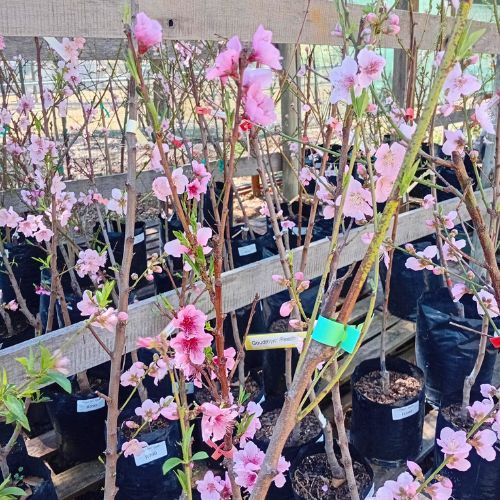
Prune Catherina Peach trees in late winter to early spring before buds swell. Remove dead, damaged, or diseased branches. Thin out the canopy to improve air circulation and light penetration, which helps prevent diseases and promotes fruit development.
Train the tree into a modified central leader or open-center shape for optimal fruit production.
Pests and Diseases
Aphids, citrus psylla, red scale, citrus greening. Spraying regularly with Agricultural Neem Oil or Effective Microorganisms (EM Control) will assist with prevention or after-the-fact control. If you already have aphids or mites, wash the tree with a harsh hosing, and when dry, spray with Neem oil or EM Control.
Practice good garden hygiene (remove fallen fruit and leaves).
Watch for root rot (if overwatered) and fungal infections during wet periods.
Thinning Fruit
Thin fruit in early summer when they are about the size of a dime to promote larger, healthier fruit and prevent branch breakage due to excessive weight.
Harvesting
Catherina Peaches typically ripen in mid to late summer, depending on the climate and growing conditions. Harvest when the fruit is fully ripe and easily comes off the tree with a gentle twist.